After my recent trouble with sitemeter, I've added Google analytics, which is described as :-
Google Analytics tells you everything you want to know about how your visitors found you and how they interact with your site.
I've seen it used before and looks interesting way of looking at who (if any) looks at your blogs.
Saturday, March 10, 2007


Thursday, March 08, 2007
Feelings of loss.......
I'm not amused. My sitemeter has gone down. It says no one's been on there for 36 hours. Its driving me crazy. I think I better get a grip.
Library 2.0 on Ning
Bill Drew has created a Ning social website for library 2.0 enthusiasts. Ning is described as :-
Ning is an online platform for creating social websites and social networks. The websites running on its service are built in standard PHP and the platform itself is built in Java.
Its a great idea by Bill and worth joining. Here's mine.
Ning is an online platform for creating social websites and social networks. The websites running on its service are built in standard PHP and the platform itself is built in Java.
Its a great idea by Bill and worth joining. Here's mine.
Wednesday, March 07, 2007
The week that was.........
Following on from last weeks article of the same title, i'm adding another 3 things I should have blogged more about on this blog. I hope to make this a regular thing. Topping the charts is :-
1. From lisnews comes the New York State Bill S2298- Protecting Children in the Internet Age. Seems very similar to DOPA or do I mean Social Networking Web Site Prohibition Act? Anyway, its another law regarding "requiring filtering software on computers in public libraries and schools to prevent minors from viewing indecent materials." Not again.....
2. Via Lorcan Dempseys blog I came accross David Rothmans blog on Shelfari and librarything. Rothman likes how you can transfer your list via librarything to shelfari, and feels this could be done via e-book downloads. I prefer a library and the physical object, but then I'm not a digital native.
3. Michael Stephens over on library crunch links to his interview with Robert Doyle (Executive Director of the Illinois Library Association) and the impact of American legislation on social networkung sites in the USA.
1. From lisnews comes the New York State Bill S2298- Protecting Children in the Internet Age. Seems very similar to DOPA or do I mean Social Networking Web Site Prohibition Act? Anyway, its another law regarding "requiring filtering software on computers in public libraries and schools to prevent minors from viewing indecent materials." Not again.....
2. Via Lorcan Dempseys blog I came accross David Rothmans blog on Shelfari and librarything. Rothman likes how you can transfer your list via librarything to shelfari, and feels this could be done via e-book downloads. I prefer a library and the physical object, but then I'm not a digital native.
3. Michael Stephens over on library crunch links to his interview with Robert Doyle (Executive Director of the Illinois Library Association) and the impact of American legislation on social networkung sites in the USA.
Tuesday, March 06, 2007
librarything and Shelfari coverage......take off in social cataloguing?
Librarything had some good coverage in the New York Times called A Cozy Book Club, in a Virtual Reading Room.
And with Shelfari getting $1million dollars investment from amazon. I like the idea of both librarything and shelfari, i'm always worried there business plan may fall down when more people suffer social networking fatigue. I suppose they'll add more features then........
And with Shelfari getting $1million dollars investment from amazon. I like the idea of both librarything and shelfari, i'm always worried there business plan may fall down when more people suffer social networking fatigue. I suppose they'll add more features then........
Monday, March 05, 2007
Ipod's don't kill people, but the law might say different......
Over on Siva Vaidhyanathan site, he has an article called Cars kill three pedestrians all over NYC (No IPods implicated) , seems to follow on from the suggestion on a Proposed On Cell Phones, iPods In Crosswalk. Seems very strange idea that ipods are causing us to walk in front of cars. Perhaps there all listening to libvibes ;)
Friday, March 02, 2007
Librarything and tagging
Tim Spalding over on librarything has a great post called Percent who tag, as a follow up to his other post (When tags work and when they don't: Amazon and LibraryThing)
In it,he says:-
'Here's some data on that issue. I compared the number of books a LibraryThing member has with whether they tag or not. The later is defined as having at least one tag, so it over-represents taggers. But the trend is clear. The more you have to keep track of, the more you tag.'
I really like to tag stuff now (I really like the new feature in blogger for tagging).
The other thing I like about the article is it also engages the user with site (librarything I'm talking about). Some social cataloguing sites forget to engage there users, but not on librarything.
In it,he says:-
'Here's some data on that issue. I compared the number of books a LibraryThing member has with whether they tag or not. The later is defined as having at least one tag, so it over-represents taggers. But the trend is clear. The more you have to keep track of, the more you tag.'
I really like to tag stuff now (I really like the new feature in blogger for tagging).
The other thing I like about the article is it also engages the user with site (librarything I'm talking about). Some social cataloguing sites forget to engage there users, but not on librarything.
Wednesday, February 28, 2007
The week that was.........
Here are the top 3 links I should have discussed over the last week. Coming in at the top:-
1. Tagging: LibraryThing and Amazon. If you like tagging then you'll love this article by librarything owner Tim Spalding.
2. I loved the story of the patron in Alaska arrested and his laptop confiscated for using the libraries wi-fi after hours. Whats that about?
3. About Five Weeks to a Social Library over on Meredith Farkas blog. This looks wicked, but I've just had no time to do it with a term paper to do.
1. Tagging: LibraryThing and Amazon. If you like tagging then you'll love this article by librarything owner Tim Spalding.
2. I loved the story of the patron in Alaska arrested and his laptop confiscated for using the libraries wi-fi after hours. Whats that about?
3. About Five Weeks to a Social Library over on Meredith Farkas blog. This looks wicked, but I've just had no time to do it with a term paper to do.
Sunday, February 25, 2007
Shelfari gets amazon investment
Nice to see the first web 2.0 company, Amazon has invested a minimum of $1 million in the company. I've spoken many times about shelfari (1, 2, 3), so hopefully Jeff Bezos can teach them a thing or to on being a web 2.0 company.
Saturday, February 24, 2007
More on DOPA and Social Networking Web Site Prohibition Act
Having discussed DOPA previously (1, 2, and that it had failed, but returned in a new guise when Senator Matt Murphy (Illinois) had introduced a new bill called Social Networking Web Site Prohibition Act, I was interested in Jenny Levine's article over on the shifted librarian blog called Senator Matt Murphy of Illinois Set to Ban His Own Blog from Libraries?.
She points out that in his blog that :-
In the blog post itself, Murphy sounds fairly reasonable and balanced, saying he filed the bill "to raise awareness of the threat predators on these sites pose to our kids" and "to advance a dialogue on how we can minimize this threat." Neither of these reasons really explains why he chose to introduce a full ban on a class of sites he can't even define (nowhere does the legislation explain what is meant by the term), but I tried to give him the benefit of the doubt as I read his responses anyway.
Unfortunately, I got as far as the 12th comment, in which Detective Bob Riordan, who is working with Murphy on this legislation, notes that Blogger is in the list of "top 10 social networking sites."
Crikey. How funny is that. You would have thought he would have at least checked his own blog out beforehand wouldn't you?
What site is Murphy's blog on? Blogger. So apparently, Murphy's current bill would ban his own site - where he hosted the "live chat" to discuss banning social networking sites in libraries - from being accessed in libraries, even by adults.in
She points out that in his blog that :-
In the blog post itself, Murphy sounds fairly reasonable and balanced, saying he filed the bill "to raise awareness of the threat predators on these sites pose to our kids" and "to advance a dialogue on how we can minimize this threat." Neither of these reasons really explains why he chose to introduce a full ban on a class of sites he can't even define (nowhere does the legislation explain what is meant by the term), but I tried to give him the benefit of the doubt as I read his responses anyway.
Unfortunately, I got as far as the 12th comment, in which Detective Bob Riordan, who is working with Murphy on this legislation, notes that Blogger is in the list of "top 10 social networking sites."
Crikey. How funny is that. You would have thought he would have at least checked his own blog out beforehand wouldn't you?
What site is Murphy's blog on? Blogger. So apparently, Murphy's current bill would ban his own site - where he hosted the "live chat" to discuss banning social networking sites in libraries - from being accessed in libraries, even by adults.in
Friday, February 23, 2007
Streamburst release of In search of the valley
Streamburst has just released In Search of the Valley on there website I hear.. Streamburst describes themselves as:-
Streamburst is an innovative and forward thinking company supplying services and infrastructure for the delivery of Television and Film Productions over the Internet.
Streamburst has sole focus on Download to Own content, no VOD (Video On Demand) or near-VOD services are planned at this time.
International Distributors, Production Companies and Website Operators can benefit hugely from the unique features that Streamburst offer:
New highly effective piracy deterrent methods that do not alienate or drive customers to piracy Content Delivery in Multiple Formats Servicing Multiple Devices
Brand / Market Specific Content Delivery,High Quality, Fully Managed and Professional Service.
Obviously i've discussed the film previously (here and here. Previously the film had been on DVD sales at $18 (with coupon, $20 without). So the new format sysatem, is a great breakthrough.
The release of the film has hit both Digg and techcrunch. Its also been entered onto the internet movie database. Good publicity if you can get it I say.
I really must recommend the film as I both worked on it in a minor degree and its what I consider I write about. Meeting such web 2.0 and open source luminaries as Tim O'reilly, Brian Behlendorf and Marc Canter (who has a wonderful voice. I mean he loves the sound of it). This film is well worth a look. And hell, there's extra's with it to, and at $8.
Streamburst is an innovative and forward thinking company supplying services and infrastructure for the delivery of Television and Film Productions over the Internet.
Streamburst has sole focus on Download to Own content, no VOD (Video On Demand) or near-VOD services are planned at this time.
International Distributors, Production Companies and Website Operators can benefit hugely from the unique features that Streamburst offer:
New highly effective piracy deterrent methods that do not alienate or drive customers to piracy Content Delivery in Multiple Formats Servicing Multiple Devices
Brand / Market Specific Content Delivery,High Quality, Fully Managed and Professional Service.
Obviously i've discussed the film previously (here and here. Previously the film had been on DVD sales at $18 (with coupon, $20 without). So the new format sysatem, is a great breakthrough.
The release of the film has hit both Digg and techcrunch. Its also been entered onto the internet movie database. Good publicity if you can get it I say.
I really must recommend the film as I both worked on it in a minor degree and its what I consider I write about. Meeting such web 2.0 and open source luminaries as Tim O'reilly, Brian Behlendorf and Marc Canter (who has a wonderful voice. I mean he loves the sound of it). This film is well worth a look. And hell, there's extra's with it to, and at $8.
Wednesday, February 21, 2007
Pet bug......SHELFARI
I wonder if i'll ever stop writting about social cataloguing sites (1, 2, 3). But i've just learnt that shelfari has added groups for its site. Wow. Brilliant. 8 months behind librarything, and they at least created a few groups themselves. Has shelfari done that? Don't be silly, thats what the users are there to do (i there world anyway).......
Tuesday, February 20, 2007
Wikipedia update part 1
Follwing up (a few days behind I know), on the demise of wikipedia, it seems I was a bit early in putting them in the dead pool.
When listening to libvibes on the 15th of february, 2007, it pointed to the following article from Lunch over IP blog. The author points out that:-
Let's start by saying that the most-digged story on this (by several thousand people) was by a blogger that was not at the conference. Laurent Haug, the producer of LIFT, has already made clear that Devouard did not say that Wikipedia is going to shut down, nor used the word "disappear" during her speech.
Oh well. Sorry about that.
When listening to libvibes on the 15th of february, 2007, it pointed to the following article from Lunch over IP blog. The author points out that:-
Let's start by saying that the most-digged story on this (by several thousand people) was by a blogger that was not at the conference. Laurent Haug, the producer of LIFT, has already made clear that Devouard did not say that Wikipedia is going to shut down, nor used the word "disappear" during her speech.
Oh well. Sorry about that.
Wednesday, February 14, 2007
Return of DOPA
Seems the demise of DOPA (Deleting online predators act) is in misinformed. Having discussed this previously (here and here, seems though that a new (but oh so similar act) is being brought forward called the Social Networking Web Site Prohibition Act by Illinois state senator, Matt Murphy. There's better analysis of this here.
Saturday, February 10, 2007
Wikipedia update
Well, following on from my earlier blog entitled Wikipedia running out of money, I got left a a comment pointing out that the quote had been taken out of context. He also pointed me in the direction of another article called Wikipedia: On the brink? Or crying wolf?. The author says:-
Hyperbole aside, there can be little doubt that the organization is indeed strapped for cash. Its worldwide operations now require 350 servers and they don’t run themselves.
Hyperbole aside, there can be little doubt that the organization is indeed strapped for cash. Its worldwide operations now require 350 servers and they don’t run themselves.
Wikipedia running out of money
Wikipedia it seems is running out of money according to 901 blog. The reporter says:-
Florence Devouard, Chairwoman of the Wikimedia foundation has told an audience at the Lift07 conference that Wikipedia has the financial resources to run its servers for another 3-4 months, and that without further funding Wikipedia “might disappear”.
Hopefully they'll sort the situation out, it would be a shame to lose it.
Florence Devouard, Chairwoman of the Wikimedia foundation has told an audience at the Lift07 conference that Wikipedia has the financial resources to run its servers for another 3-4 months, and that without further funding Wikipedia “might disappear”.
Hopefully they'll sort the situation out, it would be a shame to lose it.
Thursday, February 08, 2007
Something new, an exciting social cataloguing site
Richard Wallis on Panlibus has pointed me in the direction of a new and innovative social cataloguing site (now I didn't think I would say that recently). The site is called Revish, and not released yet but it sounds promising, as Richard writes:-
Unlike the short snappy often light-weight reviews you find on sites like Amazon, LibraryThing, etc., Ravish intends to create a community of in-depth reviewers.
I've signed up for it and will discuss it in more depth, but for now here the companies blog.
Unlike the short snappy often light-weight reviews you find on sites like Amazon, LibraryThing, etc., Ravish intends to create a community of in-depth reviewers.
I've signed up for it and will discuss it in more depth, but for now here the companies blog.
Petition to stop British library cuts
Following on from my earlier entry about the 7% cuts at the British library,I just read about this petition to stop it going through. Please do sign it.
Tuesday, February 06, 2007
Review of Blogging and Rss: A Librarians Guide
Having had a 9 hour journey in all to read this, i've finally got an opportunity to review it as promised. I think the book is well researched and full of tips. But why? Well the author looks at How to use an RSS feeder like bloglines, how to write source code and how it works in the RSS feeders. Podcasts are also discussed, and how the source code works. The coverage on bloglines is really fantastic and I learnt so many things, even though I've been using it for over 8 months. That alone make's it worth a read.
There is also a large amount of screen grabs so one can visualise what Michael is discussing. These are not intrusive either.
Michael also interviews the following library blogs as well:-
Travels with the state librarian, librarystuff
, library web chic, Walt at Random, Lorcan Dempsey
, Librarian in Black, The shifted librarian, Library Techtonics, Walking Paper, Tame the Web, Jessamyn West. They give some great advice for why you should (and shouldn't) blog, and also what they have gained from the experience.
The opening chapters also deal with how to start a cheap and inexpensive blog and the different one's you could use. He predominantly discusses blogger
, but does discuss other blog software.
Michael concludes with some links that are worth having on an RSS feeder and a quote from the cluetrain manifesto and how to get blogging.
So are there any pitfalls? Well, at first the now defunct pubsub was discussed. Thankfully, at the end he left a post note saying he'd noted its demise. Finally, Michael did forget that one should always self subscribe your own blog to see if any one's reading it ;)
Overall, this book is for any librarian interested in learning about blogs, library 2.0 or want something technical to read. So really, all librarians should read it....10 out of 10
There is also a large amount of screen grabs so one can visualise what Michael is discussing. These are not intrusive either.
Michael also interviews the following library blogs as well:-
Travels with the state librarian, librarystuff
, library web chic, Walt at Random, Lorcan Dempsey
, Librarian in Black, The shifted librarian, Library Techtonics, Walking Paper, Tame the Web, Jessamyn West. They give some great advice for why you should (and shouldn't) blog, and also what they have gained from the experience.
The opening chapters also deal with how to start a cheap and inexpensive blog and the different one's you could use. He predominantly discusses blogger
, but does discuss other blog software.
Michael concludes with some links that are worth having on an RSS feeder and a quote from the cluetrain manifesto and how to get blogging.
So are there any pitfalls? Well, at first the now defunct pubsub was discussed. Thankfully, at the end he left a post note saying he'd noted its demise. Finally, Michael did forget that one should always self subscribe your own blog to see if any one's reading it ;)
Overall, this book is for any librarian interested in learning about blogs, library 2.0 or want something technical to read. So really, all librarians should read it....10 out of 10
Saturday, February 03, 2007
Bookmooch enters second life
John Buckman, he of bookmooch has started a place for bookmoochers to congregate in second life. Cool, now i'll really have to get into second life
Friday, February 02, 2007
Social networking? Or will my users be bothered?
After watching the rise of digg and technorati and all the site's that require feedback, it seems sad when some people try this and its not as successful as it wished. For example, over on Ubiquitous Librarian blog, he was discussing how he set up an internal wiki, which just has not taken off. The problem is not usually the technology or the training that scare's people, its they don't always see its relevance or even worst, there suffering burnout from having too many social cataloguing sites...... I'm really a fan boy of the social networks sites, but people are really finding it hard to keep up with this stuff.......oh, well another rant from me, but I do hope that Brian does get the wiki up and running, sounds a great project.
Social cataloguing site.....ANOTHER ONE?
Steven Cohen's wonderful site has pointed me towards another social cataloguing site called good reads. I know I have written about it before, but do we really need another one? I know competition is good, but please do something original rather than copying librarything, shelfari, gurulib, connectedvia ad infinitum.
Thursday, February 01, 2007
33 Reasons Why Libraries and Librarians are Still Extremely Important article
A friend sent me a link called 33 Reasons Why Libraries and Librarians are Still Extremely Important. Obviously, i'm preaching to the converted (well I HOPE I am), but its great to see people try to remind some people that not everything is on the web.
Blogging and Rss: A Librarians Guide......its worth it
Just started reading Blogging and Rss: A Librarians Guide long last. Its totally brilliant so far. Michael Sauers book discusses some great idea with other bloggers, and has virtually done my research for my dissertation for me. Thankfully I have a long journey tomorrow, so will finish it and review it like some others already have.
Hands up those who want to work? except sunday and late?
I love it. Seems Wigan librarians are considering striking because of sunday opening and longer hours. I'm sorry, but aren't we struggling to gain people's attention to get them to come. Surely, with people working more hours we need to make ourselves more available to Joe Public not less? I'm with Tim Coates when it come's to reducing opening when he says:-
Because we know that the three most important aspects of the library are its stock, its building and its opening hours. If someone is to be responsible for improving the quality of the service to the local people they must be able to influence these three things, and over all three they need to have day to day tight control .
Because we know that the three most important aspects of the library are its stock, its building and its opening hours. If someone is to be responsible for improving the quality of the service to the local people they must be able to influence these three things, and over all three they need to have day to day tight control .
Blogger......I never knew that.....
British library continued
Following on from my previous post, its good to see that people are kicking up a fuss over the paying for use of the reading rooms. Now, if only we could get more people interested in the closers of our other libraries around the country, we might have a heritage worth saving.
Monday, January 29, 2007
British library to charge........did I see that coming.......
Reports in the britsh press and other blogs. One reporter wrote:-
To survive, the library proposes to slash opening hours by more than a third and to charge researchers for admission to the reading rooms for the first time.
All public exhibitions would close, along with schools learning programmes. The permanent collection, which includes a copy of every book published in the UK, would be permanently reduced by 15 per cent. And the national newspaper archive, used by 30,000 people a year, including many researching their family trees, would close.
Well, its not as if learning or having a cultural identity identity seems to matter anymore. It makes you wonder what this country represents, apart from a dirth of reality TV shows and a lack of anything else. Seems a shame the government and British library do not taking into consideration the important of libraries.
To survive, the library proposes to slash opening hours by more than a third and to charge researchers for admission to the reading rooms for the first time.
All public exhibitions would close, along with schools learning programmes. The permanent collection, which includes a copy of every book published in the UK, would be permanently reduced by 15 per cent. And the national newspaper archive, used by 30,000 people a year, including many researching their family trees, would close.
Well, its not as if learning or having a cultural identity identity seems to matter anymore. It makes you wonder what this country represents, apart from a dirth of reality TV shows and a lack of anything else. Seems a shame the government and British library do not taking into consideration the important of libraries.
library 2030 or 2010.....part 1
Having recently gone back to university for my last two semesters, one of our lecturers brought up the idea of what libraries will be like by 2030. Well, I thought I might blog this, but more hopefully this will be the library of 2010.
Change 1:- The impact of millenials.
Millenials are a follow on from Generation X and millenials are described as being:-
Sociable, optimistic, talented, well-educated, collaborative, open-minded, influential, and achievement-oriented. They’ve always felt sought after, needed, indispensable.
Millenials will become more and more to the forefront as a group of people by 2030. Unfortunately a problem with millenials is their love of feedback. As one writer pointed out:-
...this generation expects immediate and ongoing feedback, and is equally comfortable giving feedback to others...Providing feedback on their performance should play a big part, as should encouraging their creativity and initiative to find new ways to get tasks done.
Millenials' impact can already be seen in social cataloging sites such as shelfari and librarything, where people discuss books and make virtual friends and groups. Classification is often done by people generating there own tags.
Millenials, in utilising the idea of feedback loops and tagging, have made libraries take notice. In America, librarians and users want to bring radical changes to the OPAC (online public access catalog) system. Users and librarians want to allow users to have the opportunity to classify books, rather than have Dewey doing this for us.
Another example of the impact of millenials in 2030 (or 2010) upon libraries is they can aid in giving feedback to libraries. They could also be part of the advertising process to. This can already be seen to occur with the First InfoTubey Awards, which are allowing both staff and patrons to discuss libraries and advertise them. This is an area that will hopefully grow.
Change 2:- The impact of virtual worlds.
This virtual world can be seen in second life, which has brought about a flurry of businesses starting to trade in the linden dollar through selling virtual products.
Libraries have also been opened in second life. In 2030 or 2010, users could go to a virtual library and see what books they can pick up via a computer/phone or other device of the time. They can then order the book they want and collect it from a library that has it at a time that is convenient for them.
Change 3:- Enquiries and instant messenging.
IM will also become a more ubiquotus tool for enquiry desks. Advice will be sought more virtually than now from reference desks. By 2030 the reference desk will be not only about still doing checking for books via archiving etc, but also the digital aspect of archiving which has already begun. Reference desks will need to be aware of more web-based content, such as blog posts and websites.
This is the conclusion so far. I will add more idea's over the next few days.
Change 1:- The impact of millenials.
Millenials are a follow on from Generation X and millenials are described as being:-
Sociable, optimistic, talented, well-educated, collaborative, open-minded, influential, and achievement-oriented. They’ve always felt sought after, needed, indispensable.
Millenials will become more and more to the forefront as a group of people by 2030. Unfortunately a problem with millenials is their love of feedback. As one writer pointed out:-
...this generation expects immediate and ongoing feedback, and is equally comfortable giving feedback to others...Providing feedback on their performance should play a big part, as should encouraging their creativity and initiative to find new ways to get tasks done.
Millenials' impact can already be seen in social cataloging sites such as shelfari and librarything, where people discuss books and make virtual friends and groups. Classification is often done by people generating there own tags.
Millenials, in utilising the idea of feedback loops and tagging, have made libraries take notice. In America, librarians and users want to bring radical changes to the OPAC (online public access catalog) system. Users and librarians want to allow users to have the opportunity to classify books, rather than have Dewey doing this for us.
Another example of the impact of millenials in 2030 (or 2010) upon libraries is they can aid in giving feedback to libraries. They could also be part of the advertising process to. This can already be seen to occur with the First InfoTubey Awards, which are allowing both staff and patrons to discuss libraries and advertise them. This is an area that will hopefully grow.
Change 2:- The impact of virtual worlds.
This virtual world can be seen in second life, which has brought about a flurry of businesses starting to trade in the linden dollar through selling virtual products.
Libraries have also been opened in second life. In 2030 or 2010, users could go to a virtual library and see what books they can pick up via a computer/phone or other device of the time. They can then order the book they want and collect it from a library that has it at a time that is convenient for them.
Change 3:- Enquiries and instant messenging.
IM will also become a more ubiquotus tool for enquiry desks. Advice will be sought more virtually than now from reference desks. By 2030 the reference desk will be not only about still doing checking for books via archiving etc, but also the digital aspect of archiving which has already begun. Reference desks will need to be aware of more web-based content, such as blog posts and websites.
This is the conclusion so far. I will add more idea's over the next few days.
Tuesday, January 23, 2007
Hilary goes Cluetain
Seems Hilary Clinton is using the internet to start a conversation with the electorate. Very Cluetrain manifesto. There is control by her aide's what can be asked though. So the height of questions seem to be whats her favourite film (Casablanca by the way). The tagline for the film being 'Mysterious City of Sin and Intrigue !'. Sounds like Washington.............
Google Germany goes down
Techcrunch has pointed out that Google.de (Germany) went down earlier today, as they had forgotten to renew the domain name. Hell, how stupid must they feel..........
Saturday, January 20, 2007
Millenials , social networks and the library
Having watched the explosion of Digg and its copycats I discussed in passing with a ZDnet journalist about this an millenials (or net generation, generation Y etc). When will libraries and librarians give the millenials the opportunity to vote on the idea of closing libraries and individual librarians, digg style? What a great idea huh? We all know that millenials like to give and recieve feedback. Here it'll be more direct action........
Friday, January 19, 2007
Google's RSS Reader, Techcrunch
Over on Techcrunchs Mike Arrington called Just How Big Is Google Reader?. It looks at whether google rss feeder is as big as bloglines and rojo. Its an interesting analyst, and looks forward to the time that feedburner can show us if google is taking the lead in rss as much as it does search engines.
Thursday, January 18, 2007
Blogging and RSS: A Librarian’s Guide reviewed by Walt
Walt at Random has review (briefly) Michael Sauers
Blogging and RSS: A Librarian’s Guide. I also got this book. I would highly recommend the book (well, I have bought it). As my dissertation is also on the subject about libraries and blogs, I think its pretty relevant.
Connect via books
Librarystuff pointed me in the direction of a new social website called connected via books. It describes itself thus:-
We want to provide an environment where readers can share their excitement from having read a great book and where everyone, through a passionate exchange of ideas, information and knowledge, can question, learn, grow and emerge not only wiser but also having made new friends from around the world.
Its not librarything, but its worth a look.
We want to provide an environment where readers can share their excitement from having read a great book and where everyone, through a passionate exchange of ideas, information and knowledge, can question, learn, grow and emerge not only wiser but also having made new friends from around the world.
Its not librarything, but its worth a look.
Wednesday, January 17, 2007
Glad to be back
Gaving taken virtually a month off my blog,catch up on my bloglines. 1300 was a few too many too read though. What was good was reading Steven Cohen's & Blake Carver's librarystuff to revitalise my enjoyment in blogging. Another thing I notice. A month is a long time in the blogosphere.
Tuesday, January 16, 2007
Libraries as internet cafe's
The Good library blog directed me towards a Daily Mail article called Internet cafes that used to be libraries and its comments. I'm certainly not a fan of the paper (if your American, with left leaning view points think fox news). It has some interesting views but more in the comments I find. I think the one that goes as follows hits the:-
Also, library staff (who are poorly paid) are expected to be computer technicians and answer technical questions
Now, unlike most of this article, I don't mind computers in a library. Its having to assist people on the computers, when a lack of training is given to you. I like assisting people, but sometimes patrons won't even go to some of the free course's libraries run. But then, i'm in a bad mood, an perhaps i'm just ,oaning too much......................
Also, library staff (who are poorly paid) are expected to be computer technicians and answer technical questions
Now, unlike most of this article, I don't mind computers in a library. Its having to assist people on the computers, when a lack of training is given to you. I like assisting people, but sometimes patrons won't even go to some of the free course's libraries run. But then, i'm in a bad mood, an perhaps i'm just ,oaning too much......................
Monday, January 15, 2007
Congratulations.......
Having had a month off to do two term papers, its nice to be able to relax and sit down and write. Anyway, just wanted to congratulate head of Haringey Councils, Diana Edmonds on recieving an MBE. Although i'm far from like the new years honours list, I have been given the oportunity to work as a volunteer at one of her libraries. Not only as she made the libraries better for patrons, but she wants her staff to be content in there jobs. So its not only a pleasure to patronise Haringey libraries, its a pleasure working there.
Thursday, December 14, 2006
Librarything and Do ordinary users care about data portability? And if not, should they?
There is an interesting article about Do ordinary users care about data portability? And if not, should they? Four social networks respond, over on zdnet. Librarything are one of the four and well worth reading.
Wednesday, December 13, 2006
Shelfari adds blog widget
Having discussed shelfari at some length (here and here), I noted tonite they are adding a blog widget to show your shelfari bookcase. ummm. Librarything did this over a year ago. Anyhow, sorry for the lack of entries, but have to essay to do before christmas.
Thursday, November 23, 2006
Liszen trends open's on beta version.......
Wednesday, November 22, 2006
Keeping tabs on social software and media
A new blog I recently added to my bloglines, is by Stephen O'hear over on Zdnet on social media, with the tag line of 'Keeping tabs on social software and media'. Has some interesting idea's, especially the on on microsofts new mp3 player, the zune.
Open Source Podcast
I was recently sent a link of a class from Berkeley University, which deals with Open Source. The link is here, and just put on my Ipod nano (which is my new 'love object'). Check the link out. As my course on the new semester is on open source its well worth a look.
Wednesday, November 15, 2006
Book Mooch owner talking in London
The very nice John Buckman, the guy behind Bookmooch, is giving a talk at Truman Brewery, London this friday. Barcamp, the people who have instigated this describe it as:-
For those who don't have time to attend a full BarCamp, some of us have come up with MiniBar, a chance to snaffle some free beer while discussing p2p, Creative Commons, web applications, social networking and general Web 2.0 mayhem & fandango.
Unfortunately, I can't make it. Gutted. Really wanted to say thanks to John for sending Peter Morville's excellent Ambient Findability.
For those who don't have time to attend a full BarCamp, some of us have come up with MiniBar, a chance to snaffle some free beer while discussing p2p, Creative Commons, web applications, social networking and general Web 2.0 mayhem & fandango.
Unfortunately, I can't make it. Gutted. Really wanted to say thanks to John for sending Peter Morville's excellent Ambient Findability.
Wednesday, November 08, 2006
Are Liszen the new Digg?
Having already spoken about Liszen (which describes itself as 'connecting you to 500 plus blogs within the library profession). On a new article on Library Zen (Garrett Hunford's other site/blog in conjunction Liszen) called
LISZEN: Submission, Recognition & Trends (OH My). Garrett is doing an excellent job, and has brought forward the idea of :-
'LISZEN: Trends (The Best for Last)
LISZEN is more of a library community archival tool than a source for new information. So why not create something that allows users to submit and vote on content in order to create a real-time/social library tool? That’s were LISZEN: Trends comes into play. I spent last weekend tweaking LISZEN: Trends and want some user input before it’s released. On November 22nd at 5 p.m. [EST] a form will be posted allowing users to request a sneak peak. You will have until midnight on November 28th to play with the site and follow a small set of testing instructions.'
This usability feature seems like Kevin Rose's Digg site, which is described as :-
'Digg is a news website with an emphasis on technology and science articles. It combines social bookmarking, blogging, and syndication with a form of non-hierarchical, democratic editorial control.'
This reminded me of another description of what Garrett MAY be doing. This is what wired has termed meganiche, described as:-
'Meganiche sites are often based on a mainstream topic, but they carve it into divisions that the market as a whole may barely recognize..........User-generated content is the Web-biz buzzword of the day, and meganiche sites tend to produce lots of it.'
Whatever label it is, this new idea sound wicked.
LISZEN: Submission, Recognition & Trends (OH My). Garrett is doing an excellent job, and has brought forward the idea of :-
'LISZEN: Trends (The Best for Last)
LISZEN is more of a library community archival tool than a source for new information. So why not create something that allows users to submit and vote on content in order to create a real-time/social library tool? That’s were LISZEN: Trends comes into play. I spent last weekend tweaking LISZEN: Trends and want some user input before it’s released. On November 22nd at 5 p.m. [EST] a form will be posted allowing users to request a sneak peak. You will have until midnight on November 28th to play with the site and follow a small set of testing instructions.'
This usability feature seems like Kevin Rose's Digg site, which is described as :-
'Digg is a news website with an emphasis on technology and science articles. It combines social bookmarking, blogging, and syndication with a form of non-hierarchical, democratic editorial control.'
This reminded me of another description of what Garrett MAY be doing. This is what wired has termed meganiche, described as:-
'Meganiche sites are often based on a mainstream topic, but they carve it into divisions that the market as a whole may barely recognize..........User-generated content is the Web-biz buzzword of the day, and meganiche sites tend to produce lots of it.'
Whatever label it is, this new idea sound wicked.
Tuesday, November 07, 2006
Job descriptions have no relevance
In my voluntary role at the library, ALL staff often get asked to assist users with computer queries. But, do I spend 40 minutes with one person setting up email? Or explaining to users why computers floppies no longer work? Its not the helping I (totally) mind, its the not having the answers that gets more frustrating......
Friday, November 03, 2006
DOPA and 30 positive things to do on social networking
I haven't written much on DOPA for a while, but walking paper sent me to a link regarding 30 Positive Uses of Social Networking. Tere a great article on a PDF file on how to use social networking in libraries.
Thursday, November 02, 2006
Shelfari adds Safari
I love alliteration. Anyhow, after my recent blog on social cataloguing, Shelfari have listened to me when I said:-
Shelfari...... isn't currently compatible with the Safari web browser.
It is now compatabilble with Safari so an email told me. Be nice if they added to there blog though.
Shelfari...... isn't currently compatible with the Safari web browser.
It is now compatabilble with Safari so an email told me. Be nice if they added to there blog though.
Sunday, October 29, 2006
A new search tool for librarians
Ok, Librarystuff and other bloggers have spoken about this, but Liszen has just been released by Garreth Hungerford a search engine just for library blogs. I've just added myself, it looks gorgeous to. Give it a try.
Saturday, October 28, 2006
Helen Rumbelow, political correspondent for The Times of London and A response to her article
Lisnews had an article from Helen Rumbelow last night which caused me no sense of unease. Her article looked at the Idea Store in Tower Hamlets in east London.
She goes on to describe how the library in the UK is dead, saying:-
[In] the Nineties, and the internet, happened. The visitors to the library of my childhood drifted away. Almost anything you could want there, the computer could do better.
The man who shuffled in with an embarrassing medical condition to research? Far more information online, and in the comfort of your own home. Ditto almost any research project.
So everything is on Google is it? Um, well thats not true. Google has around 15 % of all written material. Libraries through inter-library loans can bring that to a higher number. But then thats just for researchers and Helen CERTAINLY is not one of them. Also libraries provide internet access to those without access for free. My library even has wi-fi for its users.Libraries are public places that create and often can sustain a community intellectually and socially.
As she's writing for london I suppose its hard for her to look beyond the realms of her Chiswick home. Not to say libraries are not declining, but they are required. Thank god I read The Guardian.
She goes on to describe how the library in the UK is dead, saying:-
[In] the Nineties, and the internet, happened. The visitors to the library of my childhood drifted away. Almost anything you could want there, the computer could do better.
The man who shuffled in with an embarrassing medical condition to research? Far more information online, and in the comfort of your own home. Ditto almost any research project.
So everything is on Google is it? Um, well thats not true. Google has around 15 % of all written material. Libraries through inter-library loans can bring that to a higher number. But then thats just for researchers and Helen CERTAINLY is not one of them. Also libraries provide internet access to those without access for free. My library even has wi-fi for its users.Libraries are public places that create and often can sustain a community intellectually and socially.
As she's writing for london I suppose its hard for her to look beyond the realms of her Chiswick home. Not to say libraries are not declining, but they are required. Thank god I read The Guardian.
Friday, October 27, 2006
Article on library improvement
Read an excellent post over on Life as I know it. Its called Improving Library Services: A Review of Techniques. Its excellently researched and really something to read.
Monday, October 23, 2006
Saturday, October 21, 2006
Librarything, Shelfari, and Gurulib: Social Cataloging Sites Compared
I have recently been looking at Social Cataloging Applications, and have previously looked (briefly) at Gurulib, Librarything, and Shelfari. I am now going to review these sites in unison and in a bit more depth, by looking at the following:
- Features.
- Look and feel / ease of use.
- Data control and ownership (can you import and export your data?).
- Community and Social Networking.
Features
Librarything

Utilises the Dewey Decimal system and many other classification schemes.
As Abby of Librarything told me:
'We get the data not only from Amazon but also from 60+ libraries around the world (using Z39.50), we have a lot of data. Dewey, LC Call Numbers, LCSH, etc. You can customize your display styles in your catalog to see data if it's not already showing up, but for most books, the classification is there!'
I think that's pretty amazing.
Librarything allows you to label a book as "received" from one of the 6 book swapping sites which the site supports.
Librarything Mobile (a version of the site designed to be read on a mobile phone or device) enables you to check whether you've got a book in your library when you're standing in a bookshop. Searches via ISBN, title, author, or tags.
Allows you to add your own tags.
Score: 7 out of 10
Shelfari

Shelfari (unlike Librarything) allows for an unlimited amounts of books on your Internet shelf (foe free). This could cause people to convert to it.
Also utilises the Dewey Decimal system.Uses some nice Ajax, although the site isn't currently compatible with the Safari web browser.
Also allows you to add your own tags.Score: 5 out of 10
Gurulib
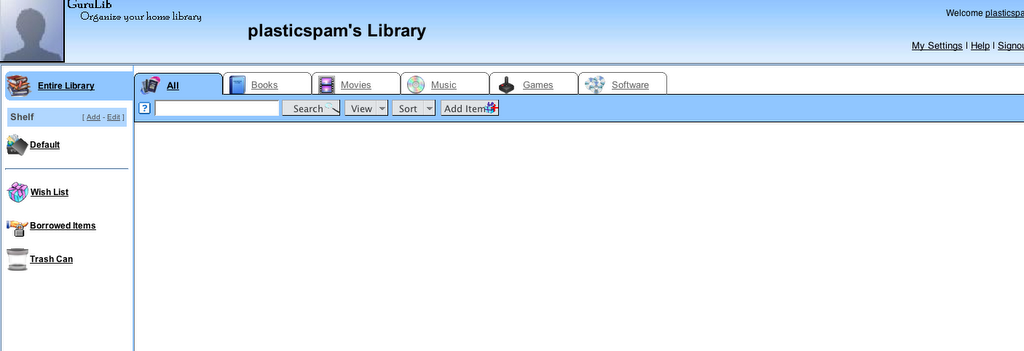
Gurulib like Shelfari is a beta version.
Gurulib does books, DVDs, games, software, and movies. These added features are a real bonus.
Gurulib says:
'Search from over 530 Public Libraries. GuruLib can access over 530 public libraries around the world to collect cataloging information about hard to find books, movie, music, games and software. If your local library support Z39.50 protocol, GuruLib can search it.'
Thats pretty good.
You can add your own titles shelves. Another form of tagging then!Allows you to scan ISBN or upc codes of objects into the system. Neat.
Gurulib also has a feature called 'Smart Price Watch':
'Set a target price for items in the wishlist, Gurulib will inform you through email when the price of the item falls beneath the target price. A graphical price history will help you know the current price trend.'
That's helpful if you want to buy a book.
Also allows you to add your own tagsScore: 8 out of 10
Look and feel / ease of use
Librarything
No disrespect but I hate the header. Is it trying to be too retro?. Obviously, if they did change it, some users might be disgruntled.Really easy to use.
Score: 7 out of 10
Shelfari
Shelfari looks a lot nicer. Out of all the sites it looks beautiful. Pity about not being compatible with Apple's Safari browser.
Again, really easy to use.Score: 8 out of 10
Gurulib
Very basic look.
Also, really easy to use.
Score: 4 out of 10
Data control and ownership
Librarything
Most importantly, Librarything allows you to import and export your data. That makes it easy to not only move your data into the site but also take your data with you, if you move elsewhere.
As Abby from Librarything explained:
'[You can] Import... your books (and many people do) from Delicious Library, Bookcollector, Amazon wishlists, Vox, you name it. Check out our "Universal Import" - or look on the Joy tab. You can also export your Librarything data (links also on the Joy tab) - we are firm believers that your data is yours - and that it should be flexible and easy to get to - to put in and to take out.'
Score: 9 out of 10
Shelfari
Only allows you to import your data but not export. Bad shelfari.
Score: 5 out of 10
Gurulib
Does not have either option that I can see.
Update: GuruLib supports exporting and importing data.
As Rana Basheer of GuruLib explained:
'Navigate to your profile page where links for exporting your entire books, movies, music, games or software will be available on the right hand side. The current export format is tab delimited and should open in excel software. The import feature was added recently. Import feature scans for ISBN/UPC/ASIN from XML/text files and then try to find the cataloging information from either Amazon databases or the public library list the user has selected.'
Score: 7 out of 10
Community
Librarything
Librarything has an advantage of having two blogs. The owner, Tim Spalding, usually adds regularly to his blog. Gives a real sense of community.Librarything is also about Social Networking. Librarything's recent introduction of groups allows for the conection of like minded people TALKING to each other.
Score: 9 out of 10
Shelfari
Shelfari also has a social networking component. As one comment left on my blog said:-
'The thing I like about Shelfari is that it's primary purpose is to share your love of reading and book recommendations with others. Social interaction relating to books gives the recommendations a personal feel and it's easy to let your friends know what you're reading and why.'
However, the site doesn't have seperate groups or communities like Librarything.
Score: 6 out of 10
Gurulib
Gurulib has a basic discussion forum.
Score: 4 out of 10
Conclusion
The marks added together are as follows and (out of 40):Librarything = 32
Shelfari = 24Gurulib = 23
I think you can see that Librarything is my favourite. I think, in comparison to the other two, Librarything really gives you that extra. Its main area I like is being able to transfer your data both into it and out of the site.
I also like the community aspect. Librarything talks to its users. Great site. The only downside is that you have to pay to add more than books to your library. But with these services I think it's worth it. The other two contenders, (who were later entrants to this space) may struggle. I think Gurulib might struggle more than Shelfari, as it does not look so aesthetically pleasing. Shelfari does really look nice, I got to say that. Gurulib in adding DVDs, films, CDs etc is really good, but unlike Shelfari and Librarything, it has no community or social networking.
This is not to say librarything should rest on its laurels (and it hasn't so far). Gurulib and Shelfari are new, and need to get a sense of community. They allow you to add as much as you want. But librarything is being very vigilant. Adding new features, talking to its users and by allowing users to move there data out as well as in, means it has to treat its users well.
Thursday, October 12, 2006
Library questionaire
Was reading Tim Coates blog, when he pointed me in the direction of a questionaire on UK libraries. I'm going to do it soon. Nice too see a fellow professional trying to get some feedback on where we're going wrong.
Shelfari.......librarything with a nicer Ajax interface
Friend showed me a called Shelfari. Its a lot nicer looking than Librarything, with a Ajax look and a real web 2.0 one as well. It allows you to tag, recommend books and discuss books as well. Excellent social software, but do I have time to transfer to all my information from Librarything to there without doing it individually? Not that I can see. Do I have the time to do this? Nope, not with a Masters course, a job, a blog and other readings. As I'd say:-
'Make it simple and easy to transfer and they will come.'
Whoops.Apologies to shelfari. You can import your librarything books. Also, another great feature is your books get the relevant Dewey Decimal number. It is very good. But, I'm so used to Librarything, it feels like cheating on a girlfriend.......
'Make it simple and easy to transfer and they will come.'
Whoops.Apologies to shelfari. You can import your librarything books. Also, another great feature is your books get the relevant Dewey Decimal number. It is very good. But, I'm so used to Librarything, it feels like cheating on a girlfriend.......
Tuesday, October 10, 2006
Longtail and the local bookstore
Techdirt have a story titled Independent Bookstores Learning How To Adjust To The Changing Market. Looking into how some local bookstore's are:-
it looks like many indie book stores are working to become destinations for the community as well, even clearing out some of the books, adding in tables along with food and drinks (including alcohol). Some are also looking to publish books on their own as well.
Sounds like the long tail in full effect.
it looks like many indie book stores are working to become destinations for the community as well, even clearing out some of the books, adding in tables along with food and drinks (including alcohol). Some are also looking to publish books on their own as well.
Sounds like the long tail in full effect.
Exhibition : Game on
My greatest love (ok, after my soccer team) is arcade game's. I loved them since I had my Sinclair ZX81. So was good to hear that At the Science Museum, London, there having a retrospective exhibition on Gaming, consoles etc, called Game On. I think my misses may wanna miss the exhibition. Perhaps I should drive there on my Raleigh Grifter? Nostalgia rocks.....
Monday, October 09, 2006
Youtube acquired
They said it would never happen. Youtube has been acquired by Google. Techcrunch, who informed us on friday the deal was on the card, revealed the deal had cost $1.65 billion. Expect loads of press coverage, for the next week.
Community in books
First off, I would like to say I am not affiliated to Bookmooch in any way or form. My entry here is just to point you in the direction of a group on bookmooch, is available on librarything. Well worth a look.
Friday, October 06, 2006
Gurulib, the new librarything?
Gurulib is described as:-
GuruLib is a free web service to help organize home libraries. Catalog your books, DVDs, music CDs, games and software online using a book shelf metaphor.
You can scan in your ISBN, review your books and tell when books have to go back. Looks ok. The scanning is a good idea, but I just feel its trying to do a similar thing to Librarything.
GuruLib is a free web service to help organize home libraries. Catalog your books, DVDs, music CDs, games and software online using a book shelf metaphor.
You can scan in your ISBN, review your books and tell when books have to go back. Looks ok. The scanning is a good idea, but I just feel its trying to do a similar thing to Librarything.
Wednesday, October 04, 2006
Gaming in libraries and education
Monday, October 02, 2006
Interview with John Buckman, owner of Bookmooch
Here is the full text of a email interview with Bookmooch owner, John Buckman. Anyway, my previous review of the sight seems to have caused a small piece of offence. Apologies for this, I'd like to think i'm a champion of bookmooch, but perhaps I was over analytical. Anyhow the interview John sent me.
Sorry for the delay, I've been in the middle of a press tour, which
is ending in a few days. I'm in Tokyo currently.
I'm a little saddened by your negative review of BookMooch. The abuse
rate is miniscule (two abuse reports for 10,000 books traded). Not
sure what is "not clean" about "the look".
Q.1/Do you feel www.bookmooch.com is the next social networking
phenomena of the social net working site? I feel your the www.myspace.com of literature?
Fundamentally, BookMooch is about trading books, not a social network
site. Everyone has books they'll never read again on their
bookshelf, and BookMooch simply helps unwanted books find places
where they are wanted. Many side-effects come out of doing this,
such as meeting people with similar book tastes, and in general,
seeing far more books now that the cost is so low, but the main goal
is bringing a huge unused resource back into the world. However,
features such as book lists, discussions, reading groups are all
planned and will come out in the next few months.
Q.2/ The use of Amazon and librarything API really add to the
usability features of your site. Whats you opinion on having access to these
API'S?
Without amazon, BookMooch would have been quite difficult to do, so
it really is a wonderful thing that they make these available.
LibraryThing came later, and Tim (the founder of LibraryThing) and I
share philosophies and greatly admire each other, so we have deeply
integrated our two web sites, and will continue to do so. I believe
a big part of Web 2.0 is understanding that users are in control, and
that users want single-purpose web sites that are optimized and best
for that use, not Web 1.0 web sites that try to capture the user and
provide all features they may ever need.
Q.3/ would you consider using more tag's for the way you describe
books? A large selection may give people a better idea of what the book is
about or a better of looking more serendipitously[hope i spelt correctly]?
Yes, of course.
Sorry for the delay, I've been in the middle of a press tour, which
is ending in a few days. I'm in Tokyo currently.
I'm a little saddened by your negative review of BookMooch. The abuse
rate is miniscule (two abuse reports for 10,000 books traded). Not
sure what is "not clean" about "the look".
Q.1/Do you feel www.bookmooch.com is the next social networking
phenomena of the social net working site? I feel your the www.myspace.com of literature?
Fundamentally, BookMooch is about trading books, not a social network
site. Everyone has books they'll never read again on their
bookshelf, and BookMooch simply helps unwanted books find places
where they are wanted. Many side-effects come out of doing this,
such as meeting people with similar book tastes, and in general,
seeing far more books now that the cost is so low, but the main goal
is bringing a huge unused resource back into the world. However,
features such as book lists, discussions, reading groups are all
planned and will come out in the next few months.
Q.2/ The use of Amazon and librarything API really add to the
usability features of your site. Whats you opinion on having access to these
API'S?
Without amazon, BookMooch would have been quite difficult to do, so
it really is a wonderful thing that they make these available.
LibraryThing came later, and Tim (the founder of LibraryThing) and I
share philosophies and greatly admire each other, so we have deeply
integrated our two web sites, and will continue to do so. I believe
a big part of Web 2.0 is understanding that users are in control, and
that users want single-purpose web sites that are optimized and best
for that use, not Web 1.0 web sites that try to capture the user and
provide all features they may ever need.
Q.3/ would you consider using more tag's for the way you describe
books? A large selection may give people a better idea of what the book is
about or a better of looking more serendipitously[hope i spelt correctly]?
Yes, of course.
Friday, September 29, 2006
Proper review of Bookmooch
Well, a proper review of Bookmooch. I have been using it and I love it. But its not brilliant. Well lets get to the criticisms. If people put up books they do not have, get the 0.1 point for a 100 non existent books, they can exchange them for books on a deception. This has been done, when 1 guy in Asia did this and was finally stopped (I read this on another article, but can't find the URL, so sorry for that). There is also the look. It could really do with a cleaner look. Also (from the same article I can't find), what about an RSS feeder for when your wishlist book comes in.
The advantages are really good. The social element of swapping books, getting trust points from feedback and being part of a network, is its major selling points. As Cronin-Lukas of The Big Blog Company said:-
"Google sells reach. Amazon sells reviews. eBay sells reputation"
Reputation really helps on this site. People come back to my bookmooch as I have positive feedback.
I got to say, its a great service, but it can still add more features.
If I find the link i will post it up to that article I can't find.
The advantages are really good. The social element of swapping books, getting trust points from feedback and being part of a network, is its major selling points. As Cronin-Lukas of The Big Blog Company said:-
"Google sells reach. Amazon sells reviews. eBay sells reputation"
Reputation really helps on this site. People come back to my bookmooch as I have positive feedback.
I got to say, its a great service, but it can still add more features.
If I find the link i will post it up to that article I can't find.
Sunday, September 24, 2006
In search of the valley goes on sale
I have just been informed that In search of the valley has just been released for sale, at $19.99. The press release of the film:-
"In Search of the Valley tells the story of three friends' personal
journey into the psyche of Silicon Valley, when in September of 2004
they swapped London for California, spending one month visiting and
talking to many of the valley's heavyweights and biggest personalities.
Directed by Steve O'Hear, and produced by Fleeta Siegel, the
resulting film is a unique interpretation of Silicon Valley – a
social fabric that has produced some of the most remarkable
technological advances of the 20th Century, and spawned an infectious
dichotomy of counterculture and entrepreneurship."
The DVD can be ordered from:
DVD order
To view the new trailer, visit:
trailer
Nice to see it released and best of luck. I hope sales go through the roof. I have an Ipod riding on this being successful.
"In Search of the Valley tells the story of three friends' personal
journey into the psyche of Silicon Valley, when in September of 2004
they swapped London for California, spending one month visiting and
talking to many of the valley's heavyweights and biggest personalities.
Directed by Steve O'Hear, and produced by Fleeta Siegel, the
resulting film is a unique interpretation of Silicon Valley – a
social fabric that has produced some of the most remarkable
technological advances of the 20th Century, and spawned an infectious
dichotomy of counterculture and entrepreneurship."
The DVD can be ordered from:
DVD order
To view the new trailer, visit:
trailer
Nice to see it released and best of luck. I hope sales go through the roof. I have an Ipod riding on this being successful.
Friday, September 22, 2006
One web day
Today is one web day. This is described as :-
We’re here to celebrate the web. And you can tell everyone that you were there for the very first OneWebDay, because this is the first of many.
Lets celebrate.
We’re here to celebrate the web. And you can tell everyone that you were there for the very first OneWebDay, because this is the first of many.
Lets celebrate.
Tuesday, September 19, 2006
book mooch......wicked
Well, book mooch is rocking the main stage. Been trying to see what books I want and what I want to get rid of. I've already got rid of one book, and sent off for two myself. If you want to see my local wears check my list here. Although the books I want are a bit specialised, once more people join, and the tipping point is reached, it'll be better. I think this is such a simple, and easy to use sight. Good, I love it.
The Medium is the Message article
i was reading Eric Schnell's excellent article If "They" Build It, Will "They" Come?. Eric discusses the Idea of how previously we felt that library websites would create "Build it, and they will come." were as now its more likely "If they build it, will they come?". Eric discusses the "1% rule in library websites. the rules says:-
It's an emerging rule of thumb that suggests that if you get a group of 100 people online then one will create content, 10 will "interact" with it (commenting or offering improvements) and the other 89 will just view it.
Eric's question, that:-
While user centered sites are great in concept, the question is how many customers will actually take advantage of the features? Does the low percentage of customers actually using the advanced features in exsisting customer / user driven warrant the cost in time and resources to build it? By the time such a site is conceived, built and deployed will the paradigm have changed yet again?
Needs to be looked into. Anyhow, as ever, well worth a read.
It's an emerging rule of thumb that suggests that if you get a group of 100 people online then one will create content, 10 will "interact" with it (commenting or offering improvements) and the other 89 will just view it.
Eric's question, that:-
While user centered sites are great in concept, the question is how many customers will actually take advantage of the features? Does the low percentage of customers actually using the advanced features in exsisting customer / user driven warrant the cost in time and resources to build it? By the time such a site is conceived, built and deployed will the paradigm have changed yet again?
Needs to be looked into. Anyhow, as ever, well worth a read.
Monday, September 18, 2006
In search of the valley exclusive photo

Having already flagrantly used my blog to advertise the release of In search of the valley (articles here and here). I thought I would add some VIRTUALLY exclusive photo's of the DVD release. Just been sent some photo's of the DVD case. Anyhow, enjoy the photo. Remember. Viral marketing doesn't work so tell your friends.
Friday, September 15, 2006
Cilip graduate open day
Went to the Cilip graduate open day today. Was very interesting, as missed out on free lunch, as I was waiting for the Infomatch person to check my CV. Was well worth it for that, and sounds like I could even get a job next year. So far off, but not too far. Anyhow, you all have a nice weekend. Moving the girlfriend to a new house, so that'll be fun.
Thursday, September 14, 2006
Book Mooch.......swap books for free
Book Mooch is described as :-
BookMooch is a community for exchanging used books.
BookMooch lets you give away books you no longer need in exchange for books you really want.
Although I discovered it today on the excellent Libvibes, and its already has large coverage on Technorati.
Its a great idea. Problem is like many people I hate getting rid of books (unless there from relatives and never what I want). Anyhow, looks good. Now let's see how many copy the idea.
BookMooch is a community for exchanging used books.
BookMooch lets you give away books you no longer need in exchange for books you really want.
Although I discovered it today on the excellent Libvibes, and its already has large coverage on Technorati.
Its a great idea. Problem is like many people I hate getting rid of books (unless there from relatives and never what I want). Anyhow, looks good. Now let's see how many copy the idea.
Monday, September 11, 2006
Is more blogging caused by excessive coffee in take?
Well, four in a day is a lot for me. Anyhow was Reading Jenny Levine's Blog entry on gaming in libraries. Seems she was in Holland and heard John Kirriemuir talk on gaming in libraries. She also provided his Powerpoint he gave. Its an interesting read for a powerpoint. It concludes as follows:-
Summary and pointers
Digital games used occasionally, but not much, in learning
Many people play them
Across many demographics
Mainstream form of entertainment
Instant response to trial and error (implications for teaching and learning)
Cognitive and neural changes and development
Encourages online exploration
Did I say “Play more games”…?
1. Preservation
2. Keep kids quiet in the library
3. Get people into the library
4. Circulating games
5. Circulating support materials
6. (Ab)using the library network
7. Input/output devices
8. Mobile library catalogue access
9. Library researcher: the game
10. Interface design
11. Accelerated online multi- tasking
12. Huge real-time social networking
Jenny, is looking into bringing more gaming to libraries and the difficulties it may bring. As a gamer, somewhere I could borrow games before buying alwats sounds good to me.
Summary and pointers
Digital games used occasionally, but not much, in learning
Many people play them
Across many demographics
Mainstream form of entertainment
Instant response to trial and error (implications for teaching and learning)
Cognitive and neural changes and development
Encourages online exploration
Did I say “Play more games”…?
1. Preservation
2. Keep kids quiet in the library
3. Get people into the library
4. Circulating games
5. Circulating support materials
6. (Ab)using the library network
7. Input/output devices
8. Mobile library catalogue access
9. Library researcher: the game
10. Interface design
11. Accelerated online multi- tasking
12. Huge real-time social networking
Jenny, is looking into bringing more gaming to libraries and the difficulties it may bring. As a gamer, somewhere I could borrow games before buying alwats sounds good to me.
Just what I thought
Over on Rick librarian blog, he has an interesting story/link to something called Pearls Pick. In an American Librarians discuss new books they recommend etc to users, and patrons can order then online. What a great idea. I wanted to do this on my (failed) blog site. Oh well.
Guardian Article
Novelist Susan Hill has entered the debate on the diminish book stock at UK Public libraries in a Guardian article. Hill states:-
"They [The Museums, Libraries and Archives Authority, a government agency] have been actively trying for years to get rid of books and introduce almost anything else,"
She feels senior civil servant, Mark Stevens remarks in which he said:-
"Public libraries have a vital role to play in helping local authorities achieve their communities' social, economic and environmental aspirations - they are much more than just places to borrow books."
Are indicative of the downward spiral and a decrease in public library stock.
She is supported in her comments by Tim Coates, who's Good library guide blog has been underlining the fact that library closure are imminent and book stock is diminishing. At least someone's doing something. Perhap's Cilip might say something. Well maybe not.
"They [The Museums, Libraries and Archives Authority, a government agency] have been actively trying for years to get rid of books and introduce almost anything else,"
She feels senior civil servant, Mark Stevens remarks in which he said:-
"Public libraries have a vital role to play in helping local authorities achieve their communities' social, economic and environmental aspirations - they are much more than just places to borrow books."
Are indicative of the downward spiral and a decrease in public library stock.
She is supported in her comments by Tim Coates, who's Good library guide blog has been underlining the fact that library closure are imminent and book stock is diminishing. At least someone's doing something. Perhap's Cilip might say something. Well maybe not.
Article on libraries and Google
I recently had a friend and he was asking how my course was going. I said the usual platitudes (enjoying it, hard work, etc). He then said, 'Why are you doing it? I can use my laptop to get all my information?' Not as if none of us haven't heard this said to us before is it? So what should my responce to this be? Well, the most obvious one is ignore them and ban them from my social network (even take them outta Facebook.
Or I could read Stephen Abram article called Waiting for Your Cat to Bark - Competing with Google and its Ilk.
The articles is in 3 stages and looks at the advantages and disadvantages of search engines and libraries, and the final part looks at how libraries an utilise search engines. The first article deals with Googles advantages and disadvantages. Next months looks at libraries, and november conclude it.
Abram's article looks at Google's slow uptake on social software (though as they bought Blogger and Writely, this is somewhat far of the mark (in my opinion). Though I must admit I agree on his final disadvantage of Google, in which he writes:-
So far, Google does local (communities, neighborhoods, clubs, etc.) poorly. Libraries were pretty good at this space – so far good libraries have a handle on that local connection – physically and psychologically. Can this be sustained? If Google and its ilk start setting their landing pages to default to a local page (for example toronto.google.com) to dominate local advertising, will our local institutions, like newspapers, schools, and libraries, be ready?
Anyhow, looking forward to next months follow up. but check it anyway.
Or I could read Stephen Abram article called Waiting for Your Cat to Bark - Competing with Google and its Ilk.
The articles is in 3 stages and looks at the advantages and disadvantages of search engines and libraries, and the final part looks at how libraries an utilise search engines. The first article deals with Googles advantages and disadvantages. Next months looks at libraries, and november conclude it.
Abram's article looks at Google's slow uptake on social software (though as they bought Blogger and Writely, this is somewhat far of the mark (in my opinion). Though I must admit I agree on his final disadvantage of Google, in which he writes:-
So far, Google does local (communities, neighborhoods, clubs, etc.) poorly. Libraries were pretty good at this space – so far good libraries have a handle on that local connection – physically and psychologically. Can this be sustained? If Google and its ilk start setting their landing pages to default to a local page (for example toronto.google.com) to dominate local advertising, will our local institutions, like newspapers, schools, and libraries, be ready?
Anyhow, looking forward to next months follow up. but check it anyway.
Saturday, September 09, 2006
Social Networking sight change Digg's open news model
Over one Wired they have an Article called Digg Fights Top Users For Control
. Seem's Digg,founder Kevin Rose has changed the algorithm for weighing and ranking stories, so as to stop spammers and gaming getting false Diggs.
Wired says:-
Digg's open news model -- stories on the site are ranked on popularity among its users -- has been criticized recently for being vulnerable to fraud or abuse.
Groups of users can bump news items to the top of the site's front door by working together in a bloc, submitting and promoting ("digging") stories together. To break up groups, Rose's proposed changes will favor news items given positive votes by users who don't know one another.
It adds:-
Since the new system aims to change the way users' submissions and votes are handled, some of the site's top users will see their importance in the insular world of Digg diminished.
Many of the site's top users spend hours on the site and forums, and they often digg each other's submissions. Because of this camaraderie, the site's top users are responsible for a disproportionate number of the stories that end up on the front door.
For example, the highest-ranked recently active user on Digg, P9, has submitted 1,334 stories. 668 of those stories have been promoted within the last 7 months. In response to the changes proposed by Rose, P9 has resigned from the Digg community.
"I will no longer no supporting Digg going forward," said P9 while announcing his resignation from the site on Thursday. "I bequeath my measly No. 1 position to whoever wants to reign... Now YOU can spend all the time, all the effort and get stabbed in the back by fellow Diggers (aptly named)."
Ummmmmm, sounds like Digg might be facing a backlash. I hope note, I quite like Digg.
. Seem's Digg,founder Kevin Rose has changed the algorithm for weighing and ranking stories, so as to stop spammers and gaming getting false Diggs.
Wired says:-
Digg's open news model -- stories on the site are ranked on popularity among its users -- has been criticized recently for being vulnerable to fraud or abuse.
Groups of users can bump news items to the top of the site's front door by working together in a bloc, submitting and promoting ("digging") stories together. To break up groups, Rose's proposed changes will favor news items given positive votes by users who don't know one another.
It adds:-
Since the new system aims to change the way users' submissions and votes are handled, some of the site's top users will see their importance in the insular world of Digg diminished.
Many of the site's top users spend hours on the site and forums, and they often digg each other's submissions. Because of this camaraderie, the site's top users are responsible for a disproportionate number of the stories that end up on the front door.
For example, the highest-ranked recently active user on Digg, P9, has submitted 1,334 stories. 668 of those stories have been promoted within the last 7 months. In response to the changes proposed by Rose, P9 has resigned from the Digg community.
"I will no longer no supporting Digg going forward," said P9 while announcing his resignation from the site on Thursday. "I bequeath my measly No. 1 position to whoever wants to reign... Now YOU can spend all the time, all the effort and get stabbed in the back by fellow Diggers (aptly named)."
Ummmmmm, sounds like Digg might be facing a backlash. I hope note, I quite like Digg.
ISBN in a tagged world.......why don't people use it?
I was reading Michael Stephens Lens Resources for LIS701 at Dominican University GSLIS by Michael Stephens and noted his book section. Not for the first time I noted that if you look at the book section, there's no ISBN number. I like the ISBN to be allowed to compare price's etc. By the way, this is not a diatribe against Michael Stephen's perse, as many library bloggers have done it. I just feel, in a Library 2.0 world, I thought we were also trying to make things easy for our users.
As Library 2.0 article by Michael E. Casey and Laura C. Savastinuk said:-
To increase both your library's appeal and value to users, consider implementing customizable and participatory services. The Library 2.0 model seeks to harness our customer's knowledge to supplement and improve library services. User comments, tags, and ratings feed user-created content back into these web sites. Ultimately, this creates a more informative product for subsequent users. Your library customers have favorite titles, authors, and genres.
Although Casey et al is discussing libraries, shouldn't we include our blogs, and the pointers to books is the most important thing we want to impart to our users?
When I review a book, I usual link to Amazon, which perhaps shows a personal biase. But we could link to librarything, which would provide feedback, via reviews etc.
Obviously, we could simply just google it, but even this can take time, and simplicity should always be what we look for in usability. Or as Jakob Nielsen says:-
Usability's job is to research user behavior and find out what works. Usability should also defend users' rights and fight for simplicity. Both aspects have their place, and it's important to recognize the difference.
Well, thats got that off my chest.
As Library 2.0 article by Michael E. Casey and Laura C. Savastinuk said:-
To increase both your library's appeal and value to users, consider implementing customizable and participatory services. The Library 2.0 model seeks to harness our customer's knowledge to supplement and improve library services. User comments, tags, and ratings feed user-created content back into these web sites. Ultimately, this creates a more informative product for subsequent users. Your library customers have favorite titles, authors, and genres.
Although Casey et al is discussing libraries, shouldn't we include our blogs, and the pointers to books is the most important thing we want to impart to our users?
When I review a book, I usual link to Amazon, which perhaps shows a personal biase. But we could link to librarything, which would provide feedback, via reviews etc.
Obviously, we could simply just google it, but even this can take time, and simplicity should always be what we look for in usability. Or as Jakob Nielsen says:-
Usability's job is to research user behavior and find out what works. Usability should also defend users' rights and fight for simplicity. Both aspects have their place, and it's important to recognize the difference.
Well, thats got that off my chest.
Friday, September 08, 2006
Internet Librarian
Internet-librarian is coming to town. Well London,uk on the 16-17th October,2006. Bloggers of Tame the web(Michael Stephens) and Panilibus (Paul Miller) will be discussing Library 2.0. As is ever with a one day conference the price is to expensive. Is it because they add a 2.0, they think they can charge times 2? £400 is just too much.
Wednesday, September 06, 2006
Book Review : CyberSelfish : A critical romp through the terribly Libertarian Culture of High tech
The test of a first-rate intelligence is the ability to hold two opposed ideas in the mind at the same time, and still retain the ability to function.
F. Scott Fitzgerald
This quote sums up my response to this book. Pauline Borsook's book, Cyberselfish.
Borsook was a former writer of Wired. It looks into the politics of Silicon Valley. First off, I love both Wired and Silicon Valley, but she soon diminish and make's me approach both with some disdain. Libertarian means :- One who advocates maximizing individual rights and minimizing the role of the state. Borsook feels that in silicon valley and wired, the area feels that the individual is more important than society. The individual has to be white,middle class and a geek. The books is in chapters and has an excellent chapter on her time at wired (and its sexist attitude). The problem with both wired and silicon valley is that they see technology as an answer to everything, and central government is the bogey man. This book is great and loved it. But i'll sum it up with a quote from :-
"As the CSU-SJ [California State University] study participant puts it, 'knowledge is viewed as data awaiting retrieval.' This restrictive notion of reading as database query, of reading for information, may suit technolibertarian, but not the rest of us so well. When I interviewed the other Microsoft billionaire, Paul Allen , for Wired, he trotted out the so-tired notion of the customizable newspaper [a blog?], delievered electronically. I explained to him that most people read a newspaper differently, skimming to be surprised, reading it precisely because they are not sure what they would find. He was puzzled, poor dear, and didn't know what I was talking about. Just as nerds constantly ask me what something I've written is about (in other words, they want a key-word precis/abstract. All writing is conceived of as technical documentation."
This book is great, as a critique of silicon valley, wired or politics. Just get it. 10 out of 10.
F. Scott Fitzgerald
This quote sums up my response to this book. Pauline Borsook's book, Cyberselfish.
Borsook was a former writer of Wired. It looks into the politics of Silicon Valley. First off, I love both Wired and Silicon Valley, but she soon diminish and make's me approach both with some disdain. Libertarian means :- One who advocates maximizing individual rights and minimizing the role of the state. Borsook feels that in silicon valley and wired, the area feels that the individual is more important than society. The individual has to be white,middle class and a geek. The books is in chapters and has an excellent chapter on her time at wired (and its sexist attitude). The problem with both wired and silicon valley is that they see technology as an answer to everything, and central government is the bogey man. This book is great and loved it. But i'll sum it up with a quote from :-
"As the CSU-SJ [California State University] study participant puts it, 'knowledge is viewed as data awaiting retrieval.' This restrictive notion of reading as database query, of reading for information, may suit technolibertarian, but not the rest of us so well. When I interviewed the other Microsoft billionaire, Paul Allen , for Wired, he trotted out the so-tired notion of the customizable newspaper [a blog?], delievered electronically. I explained to him that most people read a newspaper differently, skimming to be surprised, reading it precisely because they are not sure what they would find. He was puzzled, poor dear, and didn't know what I was talking about. Just as nerds constantly ask me what something I've written is about (in other words, they want a key-word precis/abstract. All writing is conceived of as technical documentation."
This book is great, as a critique of silicon valley, wired or politics. Just get it. 10 out of 10.
Tuesday, September 05, 2006
Does anyone care about DOPA?
Over on Librarystuff, they've a great (short) article on the DOPA Legislation.
He points out that:-
blogs about DOPA and the goal of the Save Your Space group to reach 1 Million signatures.
"[W]ith only 3,230 signatures so far, it doesn’t look like they’re going to make it. It seems that the average MySpace user is either oblivious to the legislation, or doesn’t understand it - something we could have predicted from the start."
Having already discussed DOPA (here and here), its a shame so few people are trying to stop this legislation. Lets hope it changes. And soon.
He points out that:-
blogs about DOPA and the goal of the Save Your Space group to reach 1 Million signatures.
"[W]ith only 3,230 signatures so far, it doesn’t look like they’re going to make it. It seems that the average MySpace user is either oblivious to the legislation, or doesn’t understand it - something we could have predicted from the start."
Having already discussed DOPA (here and here), its a shame so few people are trying to stop this legislation. Lets hope it changes. And soon.
Monday, September 04, 2006
Philip K Dick films
Over on Library Journal they've indicated 2 Philip K Dick films are being made. One with the awesome Paul Giamatti (who was excellent in Sideways and better still in American Splendour). I only read a few of Dick's works, but loved it. Can't wait.
I'm with the band. The social networking band......
As you can tell, going through my bloglines as usual, whilst writing new entries (trying to adhere to the 1% rule I suppose). An was on A VC Blog, who'd been introduced to this excellent new piece of social software called tourbus. Check the entry here. Tourbus is described as thus:-
You can search for shows, or if you sign up can use an iTunes playlist or Last.fm account to bootstrap your list of favorite bands, then you can get notified about shows via email / RSS / iCal.
Well worth a look though. Shame, I can't see where The Beatles are playing next.
You can search for shows, or if you sign up can use an iTunes playlist or Last.fm account to bootstrap your list of favorite bands, then you can get notified about shows via email / RSS / iCal.
Well worth a look though. Shame, I can't see where The Beatles are playing next.
Tag, your it......whoops, this is Google, label your it
As ever google has bought up another company. This come's from the well informed blog of John Battelle. Battelle says that Google has purchased the ESP game. He describes it thus:-
Google has licensed "The ESP Game", invented by Luis von Ahn, and is harnessing collective intelligence to tag images in its image database. This is just an experiment, of course. But it's a clever one - -if a critical mass of images are tagged, Google will have solved a very intractable problem for itself.
Anyway, I'd blogged previously about this before. The game is really cool. Give it a spin. Just don't tell those Google guy's we're tagging though.
Google has licensed "The ESP Game", invented by Luis von Ahn, and is harnessing collective intelligence to tag images in its image database. This is just an experiment, of course. But it's a clever one - -if a critical mass of images are tagged, Google will have solved a very intractable problem for itself.
Anyway, I'd blogged previously about this before. The game is really cool. Give it a spin. Just don't tell those Google guy's we're tagging though.
Friday, September 01, 2006
Library 2.0 article released
Michael Casey, he of library crunch fame, is co-author (along with Laura C. Savastinuk) on library 2.0. The article is over on library journal here. I would highly recommend it, as Casey is an excellent read.
Thursday, August 31, 2006
Trains get WI-FI in uk
Great news, in the uk, that WI-FI is being introduced on British rail. This will be quicker than airplanes have introduced it. Thats excellent news, as when I go away on the train, I miss my Bloglines. Full story here.
Tuesday, August 29, 2006
Back at the library.....and a nice surprise
Well, went back to my voluntary role at the library, as had a month off do my other job. So a bit weird going back. Anyhow, found a letter that I was put forward for a WOW Award, for outstanding service. Now isn't that nice. Well I thought so.
Saturday, August 26, 2006
Stepping on the feet of giants
Got sent an interesting post dealing with whether Can new media turn old? Hope Jeff Jarvis from Buzzmachine doesn't get wind of this. This guy might steal his Guardian column from him. Well. Check it.
Friday, August 25, 2006
Guns, Germs, and Steel by Jared Diamond review
I had heard previously of Guns, Germs, and Steel by Jared Diamond previously via The Ubiquitous Librarian blog. He was using it and i wondered what it was about. Well, I found a new blog which discussed it. The blog is called the Park Ranger for the Intellectual Commons (bit of a mouthful). The blog entry says:-
'Diamond proposes that those who live in more "primitive" societies seem to be smarter than those who live in first-world, industrialized nations. Why, you ask? That's where it gets interesting.......As a result, industrialized peoples have evolved over the past several thousand years with the most successful individuals being those with the greatest disease tolerance. Meanwhile, people in hunter-gatherer societies have little medical care and higher rates of mortality due to homicide/war and prey animals. To survive they must be alert to the dangers around them and quick to respond. As a result, they have evolved with the most successful individuals being those who are most alert, intelligent, and agile.'
I would love to read this if I didn't have enough to read already. Good blog to.
'Diamond proposes that those who live in more "primitive" societies seem to be smarter than those who live in first-world, industrialized nations. Why, you ask? That's where it gets interesting.......As a result, industrialized peoples have evolved over the past several thousand years with the most successful individuals being those with the greatest disease tolerance. Meanwhile, people in hunter-gatherer societies have little medical care and higher rates of mortality due to homicide/war and prey animals. To survive they must be alert to the dangers around them and quick to respond. As a result, they have evolved with the most successful individuals being those who are most alert, intelligent, and agile.'
I would love to read this if I didn't have enough to read already. Good blog to.
Social library course
Ok. late again.Information wants to be free has shown there producing a 'Introducing Five Weeks to a Social Library!'. Sounds excellent. Not sure how you get on it. But it starts in Feb.2007. check it.
Tuesday, August 22, 2006
Geo-Calc 2.0 for Mac OS X released
Wednesday, August 16, 2006
100th entry about films
Its party time. My 100th entry. Anyhow, i'm a big or J-horror as some call it. Anyhow, I read over on the Ubiquitous Librarian that one missed call is being remade and was filmed for a scene at his library. Who said libraries can't be a frightening place?
Tuesday, August 15, 2006
Blogger and new versions
Techcrunch has revealed that Blogger has a beta version (read here). Techcrunch point out the following points:-
But for now there are other features already being discussed. The big picture is privacy, tags, drag and drop layout and easier inclusion of non-textual elements.
Blogger.com will now publish individual posts to the Blogspot servers, instead of republishing the entire blog after each post. Besides making the system easier to use, perhaps this will also solve the problem of Blogger blogs republishing their entire feeds and appearing as unread in feed readers.
Privacy settings will be enabled. Blogs can be public, private or read only by invitation. Many people say that private blogs are counter intuitive and that anything you post online should be understood as being for public consumption - but the blogging software providers are betting otherwise. The privacy feature is either not turned on yet, or is not working, and RSS privacy appears to be undetermined yet. It would be interesting to see Blogger support the RSS privacy standard that Bloglines recently proposed. One thing that’s clear so far is that Google appears to intend that only readers with Google Accounts logins will be allowed to accept permission to read private blogs. That’s a cheap move.
Posts can now be tagged; no more workarounds for Blogger posts to appear in tag search engines. This will also change the composition of tag search results, as there are a huge number of Blogger blogs written by less technical users and robot sploggers.
Drag and drop layout. Both building your blog’s template and changing the position of elements later will be possible with a drag and drop interface. That’s the kind of thing that could help Blogger reclaim its position as the preeminent hosted system in terms of usability. The default template options are also more varied.
The drag and drop page gives you the option of adding an element, including 3rd party javascript. Very nice, but still not as easy to use as Typepad’s widget menu.
Feeds. Feeds for all comments and individual feeds for comments on each post. Support for RSS 2.0 in addition to Atom.
Sounds good.
But for now there are other features already being discussed. The big picture is privacy, tags, drag and drop layout and easier inclusion of non-textual elements.
Blogger.com will now publish individual posts to the Blogspot servers, instead of republishing the entire blog after each post. Besides making the system easier to use, perhaps this will also solve the problem of Blogger blogs republishing their entire feeds and appearing as unread in feed readers.
Privacy settings will be enabled. Blogs can be public, private or read only by invitation. Many people say that private blogs are counter intuitive and that anything you post online should be understood as being for public consumption - but the blogging software providers are betting otherwise. The privacy feature is either not turned on yet, or is not working, and RSS privacy appears to be undetermined yet. It would be interesting to see Blogger support the RSS privacy standard that Bloglines recently proposed. One thing that’s clear so far is that Google appears to intend that only readers with Google Accounts logins will be allowed to accept permission to read private blogs. That’s a cheap move.
Posts can now be tagged; no more workarounds for Blogger posts to appear in tag search engines. This will also change the composition of tag search results, as there are a huge number of Blogger blogs written by less technical users and robot sploggers.
Drag and drop layout. Both building your blog’s template and changing the position of elements later will be possible with a drag and drop interface. That’s the kind of thing that could help Blogger reclaim its position as the preeminent hosted system in terms of usability. The default template options are also more varied.
The drag and drop page gives you the option of adding an element, including 3rd party javascript. Very nice, but still not as easy to use as Typepad’s widget menu.
Feeds. Feeds for all comments and individual feeds for comments on each post. Support for RSS 2.0 in addition to Atom.
Sounds good.
Friday, August 11, 2006
Social networking can really take the p*%£
Read this interesting story on SIVACRACY.NET. In the story two students got drunk whilst at Illinois University and one had to elieve himself in some bushed, when a cop came along. The guy ran, whilst his friend was asked if he knew the other guy. He said no, and his friend then called him. The cop saw the name and got some more information. He then had two names and checked if they knew each other. But how? VIA Facebook. The guy who relieved himself was fined $145 and the other guy who lied $195. Hell, don't you love social networks?
Education 2.0 article
A friend sent me a great article on e-learning 2.0 they had done. There article is here,and the second part is due out soon. Its really kicking up a lot of positive feedback and well worth a read. Here is the second part.
Tuesday, August 08, 2006
Friday, August 04, 2006
DOPA article
Just been o my feeds and read an article that what I learned today pointed me to. It deals with the new DOPA act and is on the CBS site, entitled
House Misfires On Internet Safety. It covers the stupidity of the lw, with suh information as:-
If children are going to get into trouble online, chances are it won't be at school. They'll be home, they'll be at a friend's house or they could even be completely away from adult supervision using their mobile phones. Schools and libraries are relatively protected environments where adults are never far away and, for the most part, computers are in public locations that make it difficult for users to hide what they're doing.
If anything, schools and libraries should be encouraging kids to use blogging and social networking services. They have enormous educational potential for such things as writing, interviewing, collaborative research, media literacy, and photography, but even if not used as part of a formal supervised education program, they encourage kids to communicate and reach out to others.
Recommend reading for concerned librarians and parents alike
House Misfires On Internet Safety. It covers the stupidity of the lw, with suh information as:-
If children are going to get into trouble online, chances are it won't be at school. They'll be home, they'll be at a friend's house or they could even be completely away from adult supervision using their mobile phones. Schools and libraries are relatively protected environments where adults are never far away and, for the most part, computers are in public locations that make it difficult for users to hide what they're doing.
If anything, schools and libraries should be encouraging kids to use blogging and social networking services. They have enormous educational potential for such things as writing, interviewing, collaborative research, media literacy, and photography, but even if not used as part of a formal supervised education program, they encourage kids to communicate and reach out to others.
Recommend reading for concerned librarians and parents alike
Wednesday, August 02, 2006
Viral marketing doesn't work.....tell your friends
I know others have linked to this already, but hell I found it funny.
Great library 2.0 article
Everyone's favourite blog on library 2.0, librarycrunch discusses an article on what library 2.0 is.The article is entitled Library 2.0 Theory: Web 2.0 and Its Implications for Libraries. Librarycrunch describes it thus:-
He presents a very well-argued thesis that Library 2.0 is primarily a technology-centered theory. While I agree that technology does play a key role in the ability of today's library to move forward and serve more users, I am not convinced that technology can ever be the primary component in this thing we call Library 2.0.
Still worth a read though.
He presents a very well-argued thesis that Library 2.0 is primarily a technology-centered theory. While I agree that technology does play a key role in the ability of today's library to move forward and serve more users, I am not convinced that technology can ever be the primary component in this thing we call Library 2.0.
Still worth a read though.
Tuesday, August 01, 2006
Could DOPA happen in the uk
Having already been against the states Deleting Online Predators Act (DOPA) act being passed, I was thinking, 'it'll never happen here. How mistaken was I. I was watching the ITV News which was having a rant against youtube, which showed some kids in Crawley putting two girls on a roundabout, whilst 2 lads on a motorbike put there bike wheel on it and 'spin them off it'. They describe it as 'pphenomenally stupid'. Wow. Genius reporting. Watch Tony Blair say how bad this is. BTW, I can't find the link on youtube. What a surprise.
Good blog article
Just read this article from a new blog on web 2.0 called Miss Ellen did not know what to do dealing with social networking sites and how to use them. This discusses how parents can use myspace and how to use Digg. Well worth a read.
Subscribe to:
Posts (Atom)